


Safety and Liveness Guarantees
To build a reliable distributed locksing system, Redis ensure three essential properties :
Safety : Mutual Exclusive
At any given time, only one client can hold the lock for a particular resource.
Liveness A : A Deedlock-Free
If a client crashes or gets partitioned from the network, the system must eventually release the lock, so others can acquire it.
Liveness B : Fault Tolerance
As long as a majority of Redis nodes are available, clients should still be able to acquire and release locks.
IMPORTANTTraditional Failover
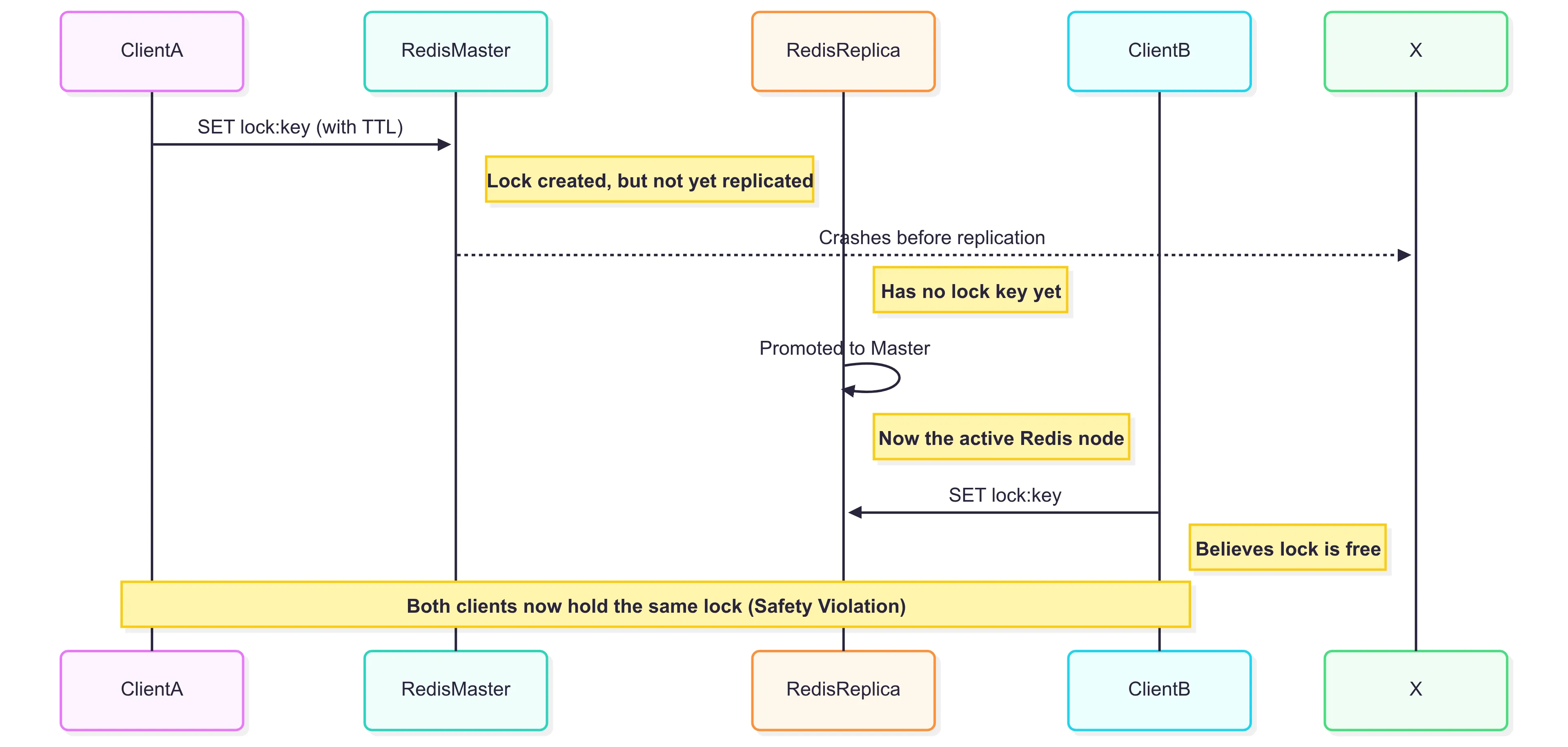
Many Redis-based lock libraries rely on a single Redis instance, possibly backed by a replica for failover.
The race condition can be illustrated with the following diagram :
What is Redlock ?
Redlock is a distributed locking algorithm designed to work with multiple independent Redis instances (e.g., 5). The idea is to use majority consensus (N/2 + 1) to safely acquire and release locks without relying on Redis replication or clustering.
How Redlock Works ?
First, run N Redis masters, e.g., 5, each on different machines to avoid correlated failures.
The client performs the following stps to acquire a lock :
- Get the current time (in milliseconds)
- Try to acquire the lock on all Redis instances using the same key and a unique random value (e.g., UUID)
- Each
SETcommand uses a short timeout (e.g, 5-50ms) to avoid hanging on unresponsive instances - After contacting all instances, the client checks :
- Was the lock successfully set on a majority (e.g, 3/5) ?
- Was it done with the lock’s validity time ? (how much time elapsed to acquire the lock ?
currentTime - timestamp in step 1)
- Evaluate success and failure handling
- If both conditions are met, the lock is considered acquired
- If not, the client releases any partial locks it acquired
WARNINGRetry Logic
When a client fails to acquire the lock, it should retry after a random short delay. This helps avoid race conditions where multiple clients are trying to lock the same resource at the same time.
TIPReleasing the Lock
The client sends a command to delete the key only if the stored value matches the original random value. This ensures that one client doesn’t accidentally reomve another client’s lock.
Handling Crashes & Persistence
Without persistence, Redis instances may forget locks after a crash, allowing other clients to re-acquire them prematurely, which breaks safety.
To improve crash recovery :
- Enable AOF (Append-Only-File) with
fsync=alwaysfor full durability. (this comes with a performance cost) - More pratical option : Delay restarting the crashed Redis instances until all old locks (TTL-based) have naturally expired.
TIPOptimizing Performance
To reducy latency, you can use non-blocking sockets and parallel
SETcommands (multiplexing) when talking to Redis instances.
Get notified via email whenever a new article is published. No spam, unsubscribe anytime.