

A Log-Structured Merge Tree (LSM Tree) is a data structure designed to efficiently handle large volume of key-value data in storage systems like SSDs or disks. It’s optimized for write-heavy workloads, making it a popular choice in modern databases such as RocksDB, Elasticsearch, Cassandra and ScyllaDB, etc.
Why Need LSM Trees
Traditional data structures like B-Trees update data in place, which results in random disk I/O, slow and inefficient on modern storage.
LSM Trees take a different approach, they buffer writes in memory, and flush data to disk in sorted batches, making them faster for inserts and updates. They also use clever background processes to keep read performance reasonable.
LSM Trees Mechanisms
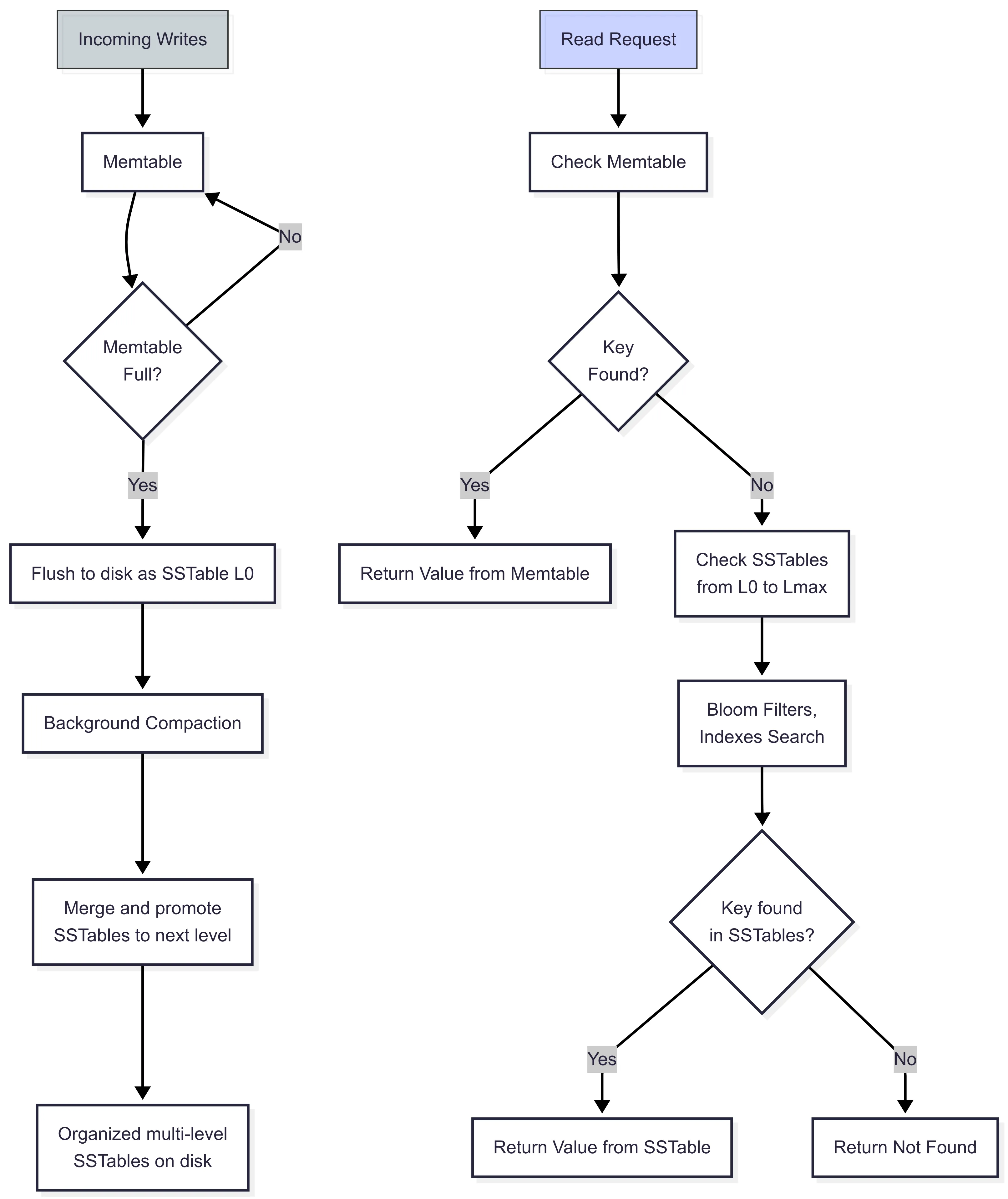
The flowchart below illustrates how an LSM Tree processes writes and reads :
1. Write Path
- New data is first written to a memory buffer called the memtable (often implemented as a red-black tree or skip list)
- Once the memtable is full, it is flushed to disk as a Sorted String Table (SSTable), a sorted, immutable file
This avoids random writes to disk and allowing batching, which greatly improves write throughput.
2. Disk Storage : SSTables and Levels
- SSTables are stored on disk in multiple levels (e.g., Level 0, Level 1, etc.), with each level larger and more organized than the previous one
- Level 0 has recently flushed data, possibly with overlapping key ranges
- Compaction periodically merges SSTables across levels to :
- Eliminate redundant or obsolete data
- Maintain sorted order
- Improve read performance
3. Read Path : Layered Search
When a key is queried :
- Check the memtable (in-memory)
- If not found, Bloom filters help quickly rule out SSTables that don’t contain the key
- Then, SSTables are searched from newer to older, starting from Level 0 and going deeper only if needed
Each SSTable uses binary search and sparse indexes to locate data quickly
NOTEbloom filter
A Bloom filter is a space-efficient probabilistic data structure that is used to test whether an item is a member of a set. (The bloom filter always say yes if an item is a set member. However, the bloom filter might still say yes although an item is not a member of the set, which is called a false positive.)
sparse indexes
Sparse indexes only contain entries for documents that have the indexed field, even if the index field contains a null value. This index skips over any document that is missing the indexed field.
Optimizations in LSM Trees
LSM Trees are packed with design choices that make them efficient :
| Optimization | Description |
|---|---|
| In-memory buffering | Writes go to RAM first — faster than disk. |
| Batched disk writes | Memtables are flushed in large batches, reducing write amplification. |
| Append-only storage | SSTables are immutable and written sequentially, ideal for SSDs. |
| Compaction | Cleans up, merges, and reorganizes data to keep reads and writes fast. |
| Bloom filters | Prevent unnecessary disk reads during lookups. |
| Sparse indexes | Index only a subset of keys to reduce memory usage and speed up searches. |
Tuning and Flexibility
LSM Trees can be tuned for different workloads :
- Faster reads : use more aggressive compaction and caching
- High write throughput : use larger memtables and delayed compation
- Massive datasets : scale by adding more levels and disk space
B-Trees vs Log-Structured Merge-Tree (LSM Tree)
| Aspect | B-Trees | LSM Trees |
|---|---|---|
| Design | Balanced tree, in-place updates | Multi-level, append-only write |
| Writes | Moderate, random I/O | Fast, batched, sequential |
| Reads | Fast and consistent | Slower, multi-level lookup |
| Memory Use | Minimal buffering | Writes buffered in memory (memtable) |
| Compaction | Not needed | Required to merge and reorganize data |
| Best For | Read-heavy or balanced workloads | Write-heavy workloads |
| Examples | MySQL, SQLite | RocksDB, Cassandra |
Get notified via email whenever a new article is published. No spam, unsubscribe anytime.