


Introduction
Istio helps manage traffic routing, security and observability between micorservices, acting as a control layer for communication.
Key benefits :
- Secure traffic : mutual TLS, authentication, and authorization
- Smart routing : e.g., load balancing, retries failover, and fault injection
- Trafic policies : e.g., rate limiting, quotas, and access control
- Built-in observability : metric logs, and distributed tracing
- No need to rewrite services : Istio works at the infrastructure level
Istio’s Architecture and Operation
Istio uses proxies (typically Envoy) to intercept and manage traffic between services. These proxies are managed by a control plane that dynamically applies routing, security, and policy rules.
It supports two modes :
| Mode | Description |
|---|---|
| Sidecar Mode | Each pod has its own Envoy proxy to handle traffic. |
| Ambient Mode | Lightweight option that uses a per-node Layer 4 proxy and optional per-namespace Envoy for Layer 7. |
NOTEeBPF’s Role in Istio
Istio does use eBPF, for efficient traffic redirection, but not for complex tasks like deep traffic inspection or Layer 7 routing. That’s because eBPF runs in the kernel and wasn’t designed for high-level processing like what Envoy does in user space.
CNI Plugins vs Istio
While some CNI plugins offer basic service mesh capabilities, they are platform-specific and often lack the full features set and compliance of Istio’s standard-based, cross-platform approach.
IMPORTANTWhy not just use one proxy per-node
Running a shared proxy per node (for all services) creates security risks. If services from different tenants share the same proxy, it’s hard to isolate them.
In ambient mode, Istio solves this by :
- Keeping node-level proxies (ztunnel) focused only on Layer 4 traffic
- Offloading complex Layer 7 logic to per-namespace proxies, avoiding multi-tenant risks
Architecture
Istio’s architecture is divided into two main parts : the data plane and the control plane
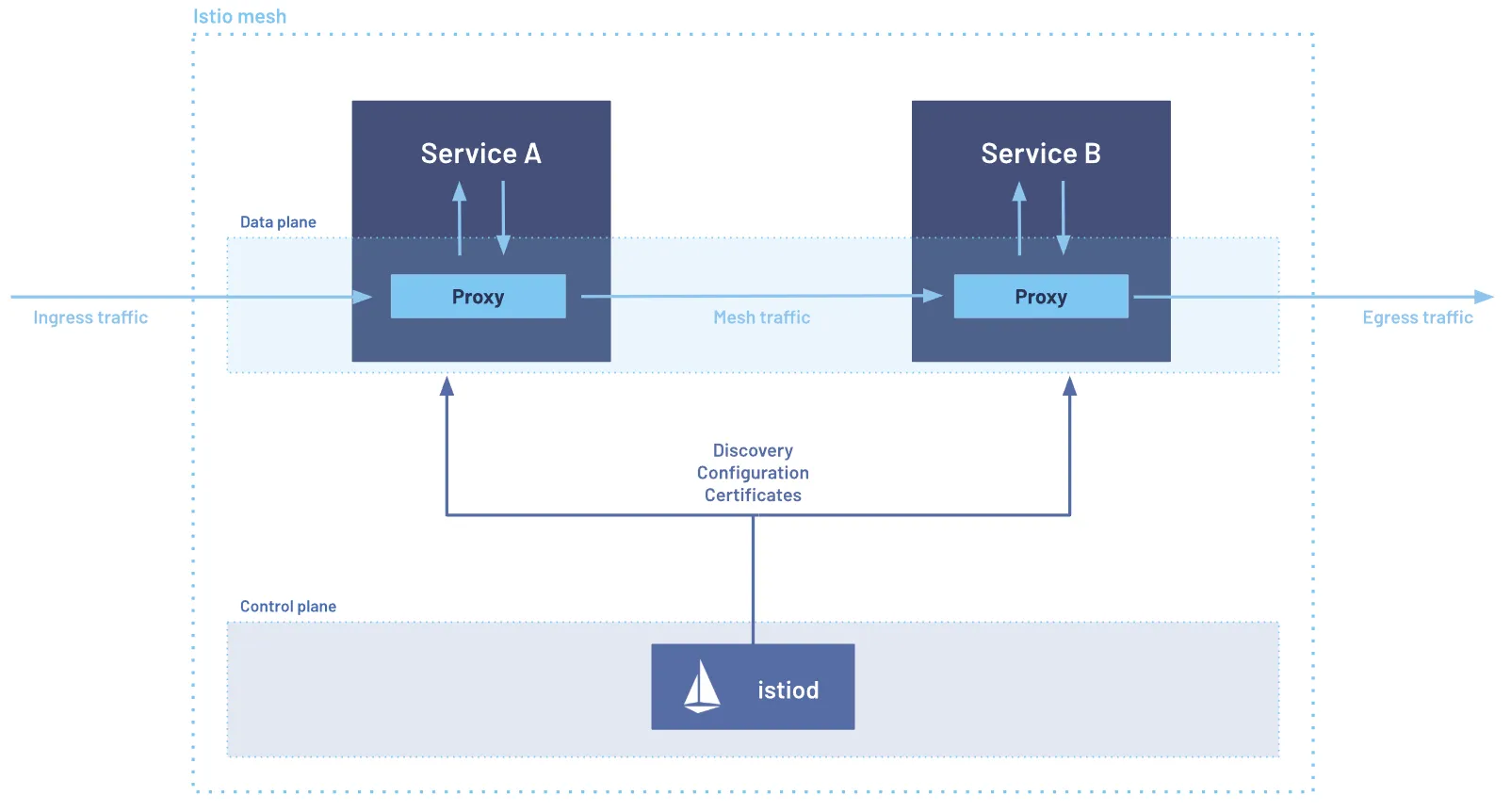
- The data plane consists of lightweight Envoy proxies deployed as sidecars alongside application services. These proxies handle all incoming and outgoing traffic for each service, allowing Istio to manage, secure, and observe communication across the mesh.
- The control plane is responsible for configuring these proxies. It defines how traffic should be routed and ensures policies like security and traffic rules are consistently enforced.
Istiod
Istiod is the central component of Istio’s control plane. It manages service discovery, configuration distribution, and security features like certificate management.
Key responsibilities of Istiod include :
- Translating high-level traffic rules into Envoy-specific configurations
- Distributing configurations to Envoy sidecars at runtime
- Agggregating serviec discovery data from multiple platforms (e.g., Kubernetes, VMs)
- Managing mutual TLS (mTLS) identities and certificate rotation
- Enabling fine-grained traffic management, security policies, and access control
Acting as a Certificate Authority (CA), Istiod ensures that all communication in the service mesh can be encrypted and authenticated using mTLS.
Get notified via email whenever a new article is published. No spam, unsubscribe anytime.